Market Developments
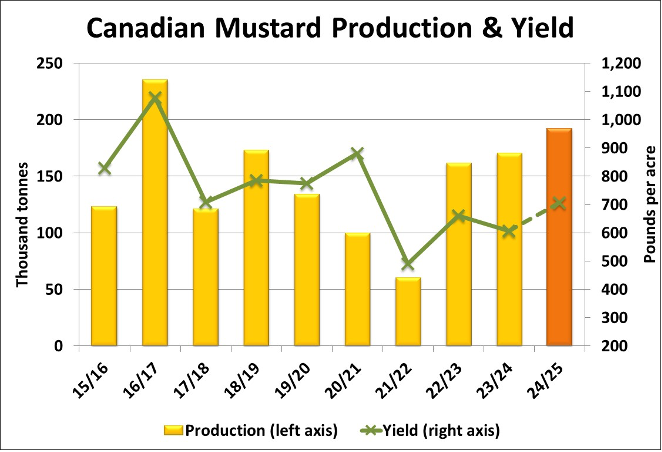
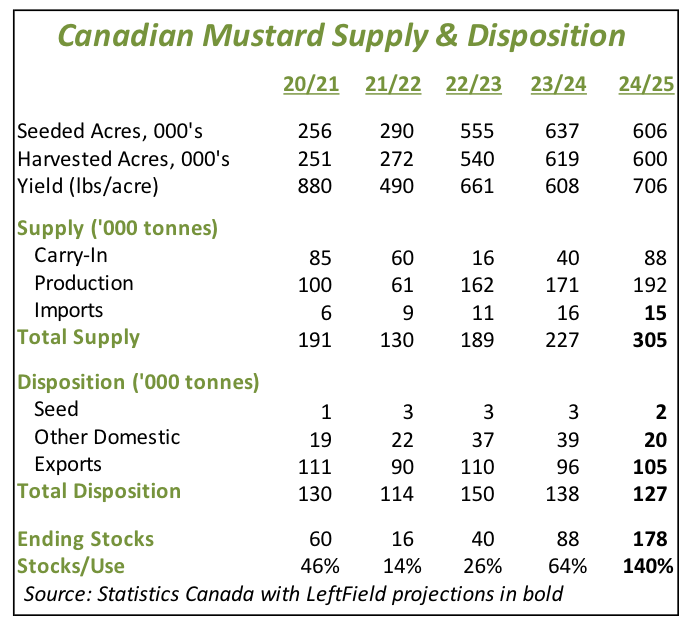
- In keeping with StatsCan’s tendency to show a smaller mustard crop estimate in December, production was pegged at 192,000 tonnes, back down to its August estimate. Despite a 5% drop in seeded area, the 2024 yield of 706 lb/acre was nearly 100 pounds more than last year, which resulted in a 13% larger crop for 2024.
- There were several gaps in StatsCan’s breakdown by type, but we’ve penciled in estimates for a 2024 brown mustard crop of 50,000 tonnes, 16% less than last year and 35,000 tonnes of oriental mustard, down 29% from 2023. By contrast, yellow mustard production would end up just under 110,000 tonnes, 70% more than last year. The combination of a larger 2024 crop and bigger old-crop carryover would push 2024/25 supplies to 305,000 tonnes, the most since 2005/06.
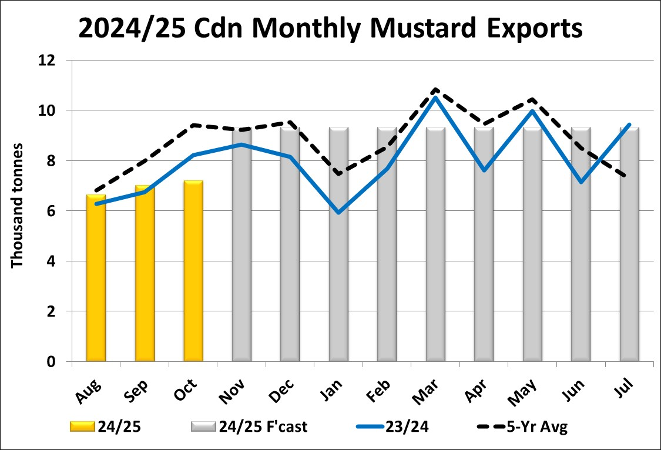
- In addition to heavy mustard supplies in 2024/25, exports through the first quarter have been subpar. Exports in October rose slightly to 7,200 tonnes but that’s still below last year’s weak performance of 8,200 tonnes and less than the 5-year average for the month of 9,400 tonnes. So far, we haven’t lowered our full-year export forecast of 105,000 tonnes but volumes will need to improve sharply to reach that target. The threat of US tariffs may have triggered some extra sales in December and early January but that could simply mean quieter exports to the US later in 2024/25. More brown mustard exports to the EU are also possible in the second half of the marketing year due to the tariffs on Russian mustard.
- Mustard exports by Ukraine were already strong halfway through 2023/24 but really ramped up late in the year when the EU announced it would be placing tariffs on Russian crops as of July 1. Through the first three months of 2024/25, the pace of Ukrainian exports is even stronger. While the volumes aren’t huge, with 8,200 tonnes by the end of September, Ukrainian mustard has increased its share of the EU market considerably. We don’t have an estimate of Ukrainian mustard production for 2024, but reports indicate farmers are growing more niche crops, including those destined for the EU. As a result, we would expect exports should be able to at least match, if not surpass, the 2023/24 total.
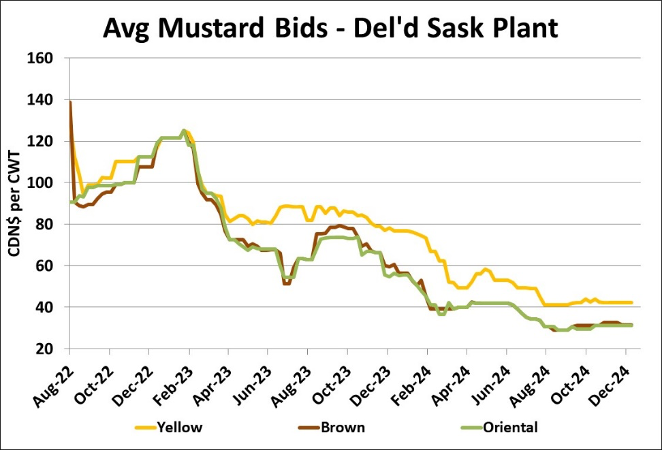
- The average yellow mustard bid has perked up, likely in response to some fresh US buying ahead of the threatened tariffs. There is a wide range in bids though between the active and nonactive buyers and once this demand has been satisfied, the high-end bids could slip back again. Bids for brown and oriental mustard are still flat due to heavy supplies. The first new-crop bids aren’t much lower than spot prices, but farmers may not find them “interesting” enough to actually sign production contracts.
Outlook
Even though StatsCan trimmed its mustard crop estimate, supplies are still at multiyear highs. Yellow mustard bids are seeing a bit of strength over concerns about import tariffs as US buyers look to build up inventories, but those gains could easily fade again. A bit of strength for brown mustard could show up later in 2024/25 as European demand shifts toward Canada, but the upside potential is limited. Overall though, lack of farmer selling is the main reason that prices haven’t slipped further.